What Are FluxNodes
FluxNodes are the decentralized servers that power the FluxCloud network. Each FluxNode is a physical or virtual machine running FluxOS, contributing compute, storage, and networking capacity to support applications on the platform. In effect, they form the decentralized infrastructure layer of FluxCloud.
FluxNodes are permissionless and open to everyone—anyone with the required hardware specs and FLUX collateral can join the network.
Ways to Deploy a FluxNode
You can join the Flux network through several deployment options:
- Legacy FluxNode – The original FluxNodes running on common Linux distributions. They require manual installation and maintenance. Legacy nodes will continue earning standard block rewards but will only receive FluxCloud revenue rewards if upgraded to ArcaneOS.
- ArcaneOS Node – Flux’s next-generation operating system for nodes (released 2025) with built-in security, automated updates, and self-maintenance. ArcaneOS is the only setup eligible for Progressive Node Rewards (PNR) — a system that shares FluxCloud application revenue (80% to ArcaneOS operators, 20% to ArcaneOS application hosts). Migrating to ArcaneOS maximizes rewards and reduces maintenance effort.
- Titan Node – Participate with a smaller stake (minimum 50 FLUX) and minimal hardware requirements. Instead of hosting your own server, you stake via the dashboard to run a Titan Node on enterprise-grade machines managed by InFlux Technologies Limited.
- Managed Service – A third-party sets up and operates the node for you while you retain custody of your FLUX collateral. This is ideal for those who prefer a hands-off approach.
For full details and setup instructions, see:
Legacy FluxNode | ArcaneOS FluxNode | Titan Node Staking | Managed FluxNode Service
FluxNode Requirements & Tiers
FluxNodes are structured into performance-based tiers, each requiring increasing hardware specs and FLUX collateral. For example, the entry-level Cumulus node requires a 1,000 FLUX stake, 2 CPU cores, 8 GB of RAM, and 220 GB of storage. Higher tiers such as Nimbus and Stratus require significantly more: up to 40,000 FLUX, 8 cores, 64 GB of RAM, and 880 GB of storage. All nodes must pass a benchmark test before joining the network.
Below are the minimum requirements for each FluxNode tier. Make sure your server has these available:
| Node Tier | Collateral | CPU | RAM | SSD / NVMe | Bandwidth | Public IP | Uptime |
|---|---|---|---|---|---|---|---|
| Cumulus | 1,000 FLUX | 2 cores / 4 threads | 8 GB | 220 GB | ≥ 25 Mbit/s | Required | ~97% uptime |
| Nimbus | 12,500 FLUX | 4 cores / 8 threads | 32 GB | 440 GB | ≥ 50 Mbit/s | Required | ~97% uptime |
| Stratus | 40,000 FLUX | 8 cores / 16 threads | 64 GB | 880 GB | ≥ 100 Mbit/s | Required | ~97% uptime |
Network Incentivization & Block Rewards
FluxNodes are financially incentivized to remain online, meet performance benchmarks, and contribute resources to the network. When operating within the required standards, FluxNodes earn block rewards from the Flux blockchain. Nodes that drop below the availability or performance threshold are automatically deactivated by the protocol to maintain network reliability.
Reward Structure
Flux uses a dual-reward model for node operators:
- Native FLUX Block Rewards
- The block reward launched at 14 FLUX per block (block 2,020,000, October 2025) and is reduced by 10% every 1,051,200 blocks (about once a year). The split between tiers stays the same.
- From block 3,071,200 (late October 2026), each block produces 12.6 FLUX:
- 0.9 FLUX → to one Cumulus node (1 FLUX at launch)
- 3.15 FLUX → to one Nimbus node (3.5 FLUX at launch)
- 8.1 FLUX → to one Stratus node (9 FLUX at launch)
- 0.45 FLUX → to an ecosystem development fund allocated to the Flux Foundation (0.5 FLUX at launch)
- Live earnings statistics: Flux Rewards Dashboard
- Parallel Mining Rewards
- In addition to native FLUX, node operators earn parallel assets (tokens on other blockchains such as ETH, BSC, KDA, SOL, etc.).
- For each parallel asset, 10% of the node reward is distributed per block (≈ 1.215 FLUX worth from block 3,071,200; ≈ 1.35 FLUX worth at the 14 FLUX launch rate).
- Once all ten parallel assets are active, this totals 100% of the node reward in parallel assets (≈ 12.15 FLUX worth per block from block 3,071,200), effectively doubling total earnings.
- Parallel mining rewards are not automatically paid to your wallet — they must be manually claimed via the Fusion app in Zelcore. Follow this guide to learn more.
Timeline & Retroactive Rewards
- Parallel mining launched: March 27, 2021.
- Rewards for new parallel assets are retroactively claimable back to the block height of their introduction.
- This means when a new asset launches, node operators can claim all rewards accrued since the relevant hard fork.
Progressive Node Rewards (PNR)
With the launch of ArcaneOS, Flux introduced the Progressive Node Rewards system:
- 80% of FluxCloud application revenue is shared among ArcaneOS node operators.
- 20% is distributed to ArcaneOS nodes hosting applications.
- Legacy nodes do not receive PNR, so upgrading to ArcaneOS is recommended for maximum rewards.
- More details: see Ways to Deploy a FluxNode.
Key Network Statitics
The Flux network is highly decentralized by design. As of mid-2025, it has over 10,000 nodes distributed across 66+ countries and operated by more than 560 independent infrastructure providers. This global spread eliminates single points of failure. If a region suffers downtime due to a power outage or natural disaster, the workload is seamlessly redistributed to other nodes, ensuring application uptime and resilience against censorship or disruptions.
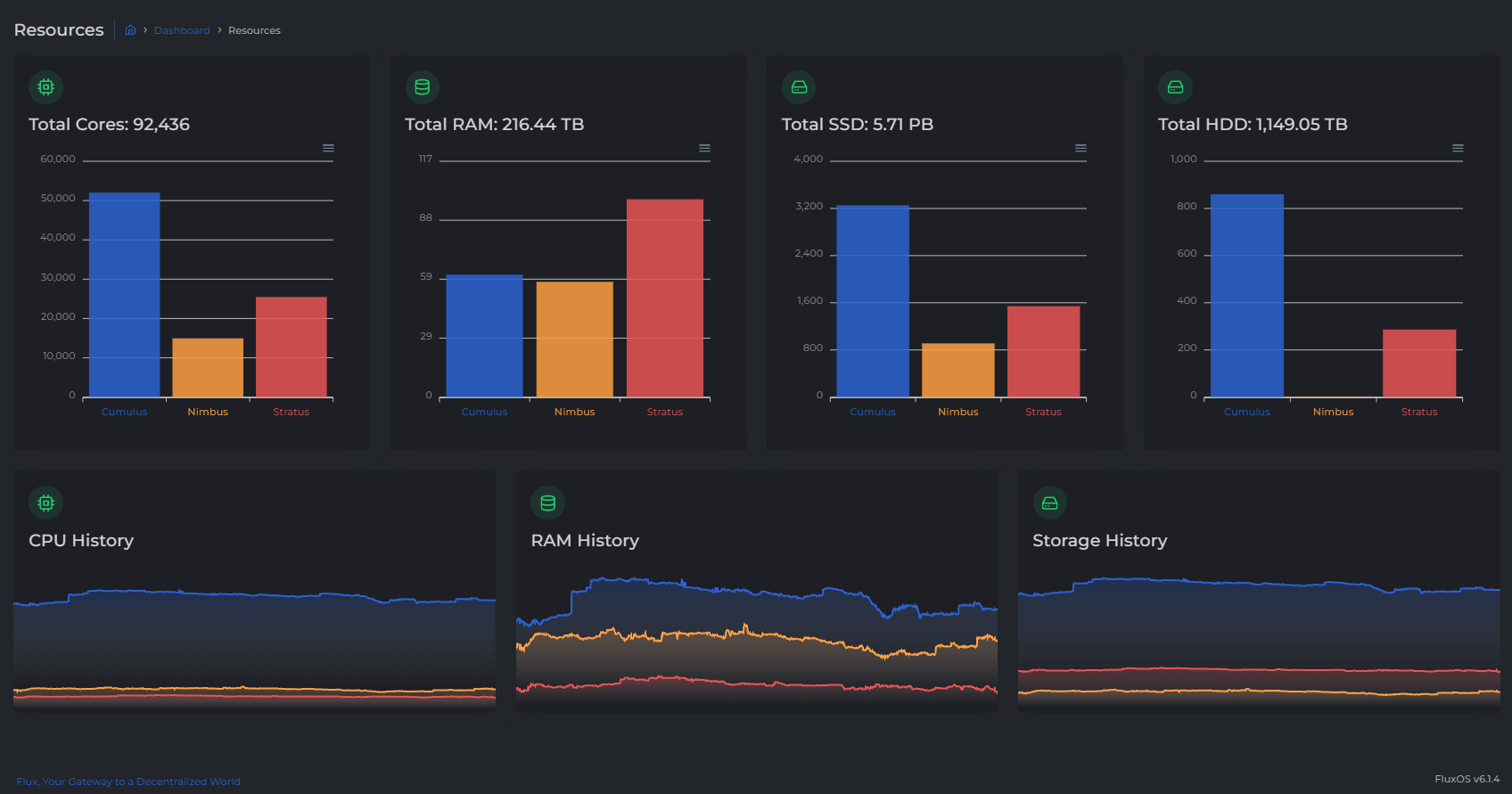
Total Resources (Live stats: https://cloud.runonflux.com/dashboards/resources)
- Total Cores: 91,370
- Total RAM: 216.62 TB
- Total Storage: 6.80 PB
Geolocations & Providers (Live stats: https://cloud.runonflux.com/dashboards/locations)
- Geographic Coverage: 66 countries
- Infrastructure Providers: 560
.png)